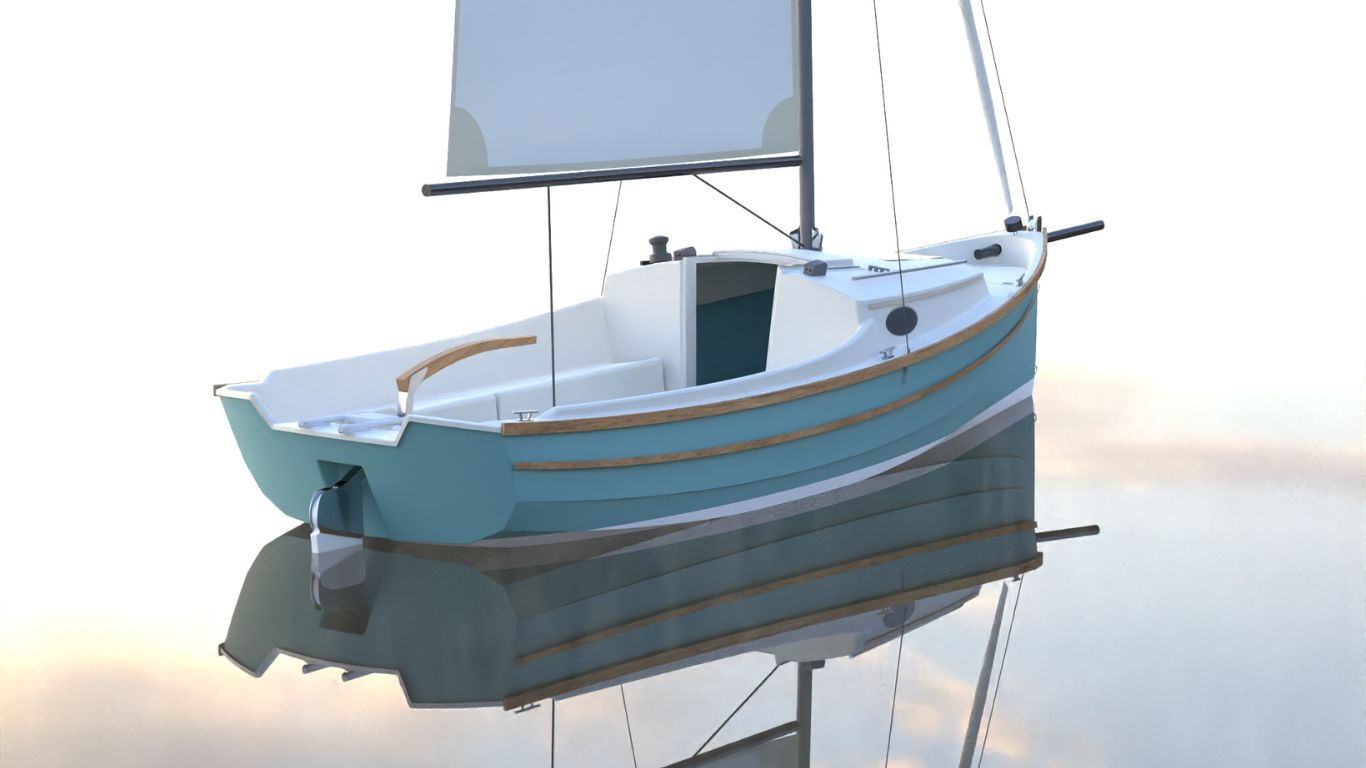
| BayRaider |
|
|
|
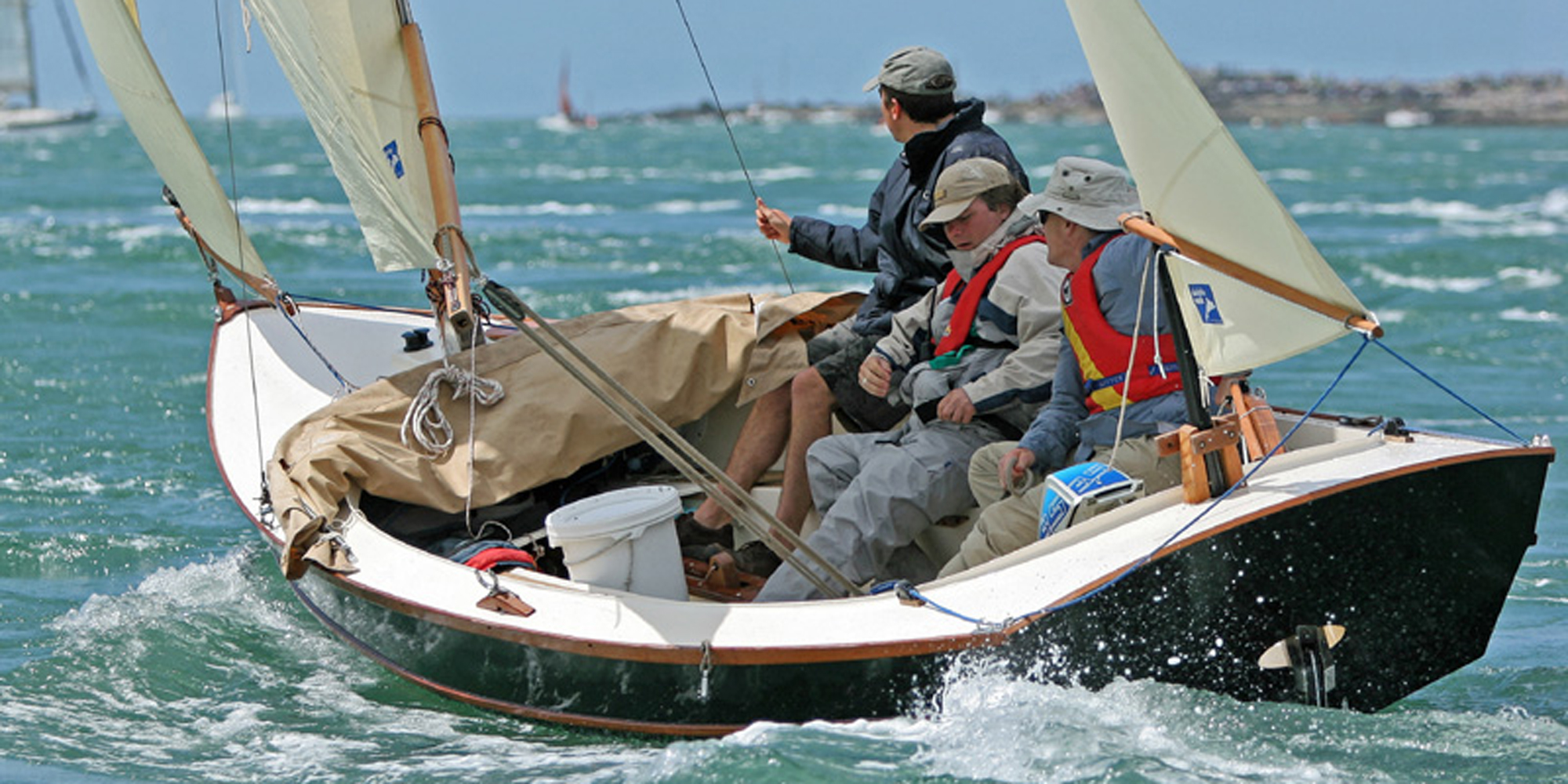
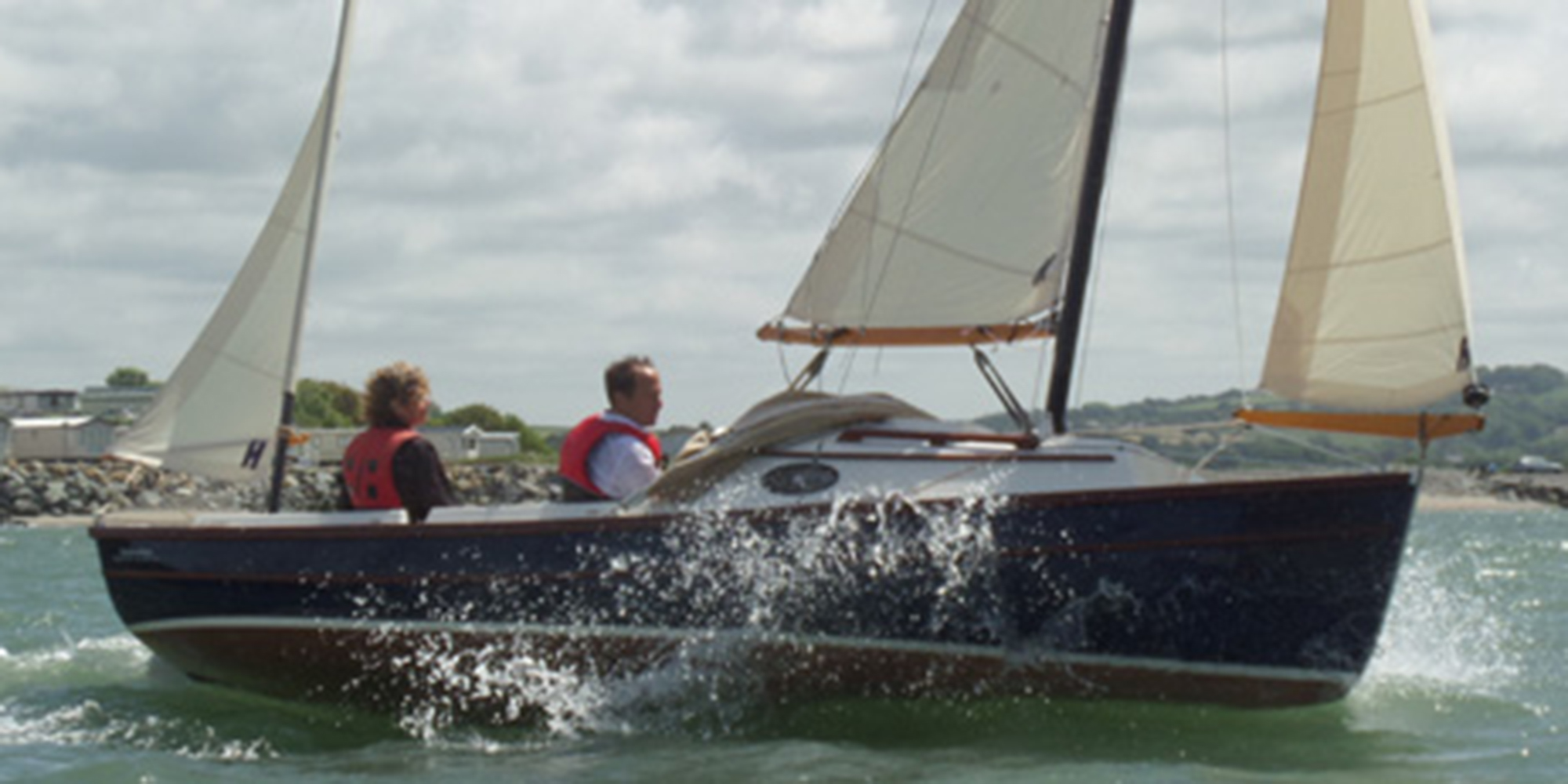
Draft up: 9ins (250mm) Down: 4ft 8ins (1.42m) Sail Area:183 sqft (17sqm) Safety Her most unique feature is the water ballast system, effectively giving the owner two different boats for the price of one. Waterballast gives you the option to fill the under floor tank with 300kg of water, giving huge amounts of stability and nearly doubling her weight. If you are unsure of the conditions, sailing singlehanded, or have nervous crew on board it is very comforting to know that with the tank full she self rights from a 90 degree knockdown. Even with thetank empty she is extremely easy to right singlehanded (see capsize video link at the bottom). Unusually for an open boat she has a self draining cockpit, which again is of huge benefit to safety. Large green waves coming in over the side can be drained rapidly through the outboard well without anyone needing to bail. The skipper is free to concentrate on the situation in hand, without worrying about getting rid of water. Her ketch rig has been well proven on many of our other boats. Its one huge advantage over a single mast rig is the ability to quickly and massively reduce sail. Under jib and mizzen alone she is well balanced, very stable and able to tolerate virtually any weather. She has many other built in safety features - you can read about them by clicking on the link at the bottom of this page Holding the jib out when running gives a little extra speed. The Golfe has powerful tides and sometimes very choppy conditions Performance After safety the next most important design feature for the BayRaider was performance and certainly in terms of traditional style dayboats, she is hard to beat. She has a gunter rigged mainsail with a luff pocket encasing the carbon top mast. This gives excellent aerodynamics and means that reefing also reduces the height of the topmast, and thus the windage. The other huge advantage with the gunter rig is the reduced length of main mast for easy trailing. The mast is hinged at the tabernacle (at deck level) and stays bolted to it for trailing, making her quick to step, ready for sailing. Her hull has plenty of form stability so in light winds, or with experienced crew on board you can leave the ballast tank empty (or empty it on the move) and transform her into something approaching a racing dinghy. Add toe straps and her wide side decks provide seating for hiking out to maximise her performance. Her jib can be rigged conventionally, but most customers prefer the balanced jib boom, which makes her self tacking and maintains excellent luff tension. The mizzen is also very much a driving sail. Though not the most efficient way of adding sail area, it is nonetheless a significant contributor. The mizzen also sits in a luff pocket and has a sprit boom rig which helps it hold shape when on or off the wind. One pull on the mizzen sheets in even a light breeze with tell you how much work it is doing. Her hull shape has been carefully optimised to produce an easily driven hull that has good form stability for carrying sail. Her flat run aft gives her the potential to semi plane and surf in the right conditions. The foils (rudder and centreboard) on BayRaider have also been carefully CAD optimised and cut to exact NACA cross sections. This makes a huge difference to windward performance – one of the reason why she beats so many trad boats is their flat steel plates which provide such a small amount of lift. Would you fly in a plane with flat wings? The Asymmetric Spinnaker is launched through a deck chute and adds considerable off wind performance. More photos to follow. One of the weaknesses of modern high aspect ratio sails is their downwind performance - the reason why spinnakers were invented. The BayRaider has an optional asymmetric spinnaker kit which is launched through a chute on the foredeck. This gives superb off-wind performance though it should be used with caution in stronger winds. We do have plans also for an optional mizzen asymmetric, basically the same thing but hoisted from the mizzen, and tacked to one gunwale, lying across the boat. We hope to post some photos soon.
Versatility The BayRaider is extremely versatile. The waterballast is an excellent safety feature but also makes her suitable for a wide range of conditions and levels of crew experience. She is an ideal boat for beginners as novices can learn with the tanks full, but empty them as they gain experience. The waterballast also makes her light enough to be pushed around on her trailer single handed on your drive, and towed with an ordinary car. Best of all it gives you much better performance in light to medium winds as you can leave all 300kg of it behind and enjoy a responsive and relatively lightweight dinghy.
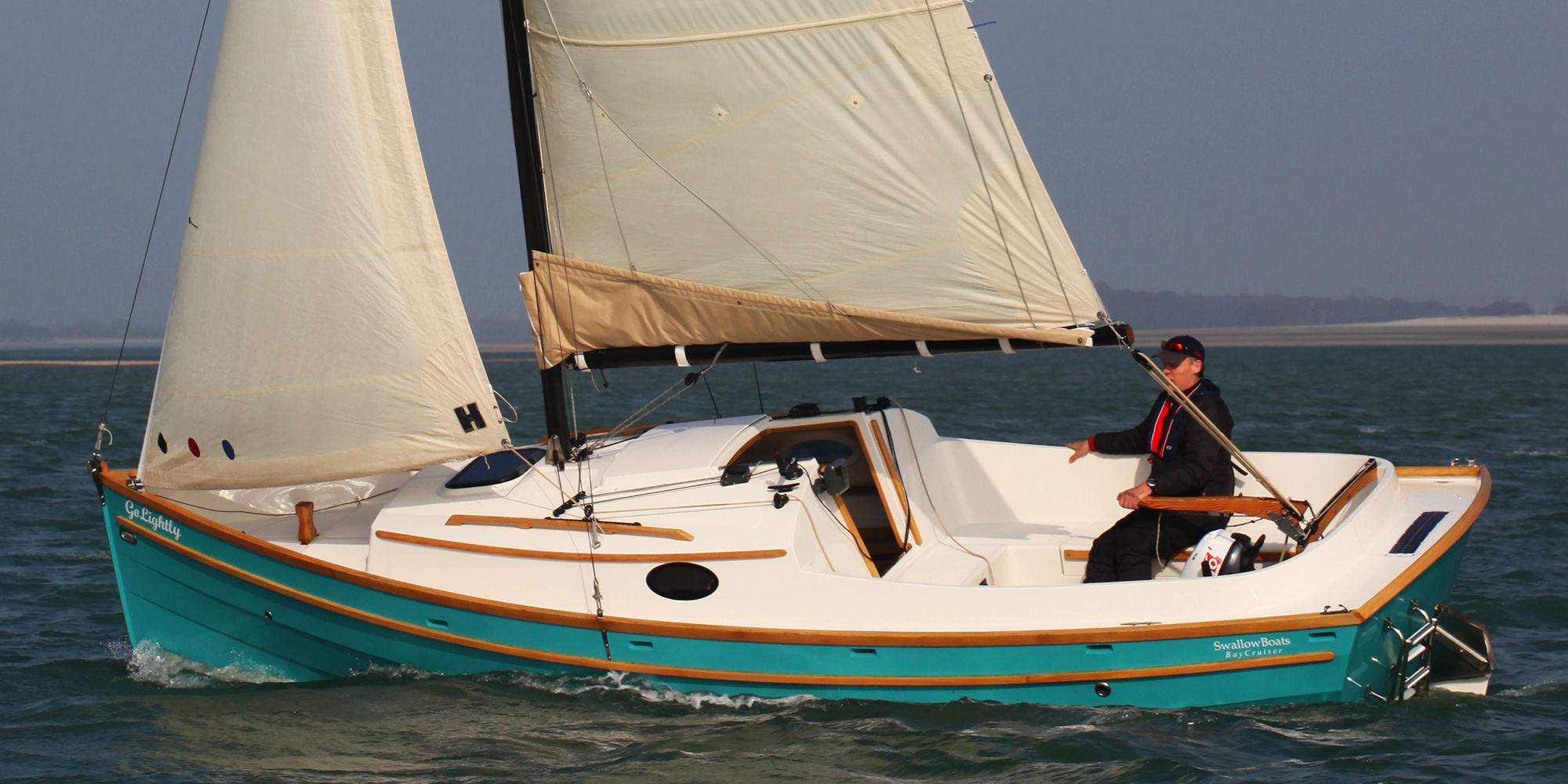
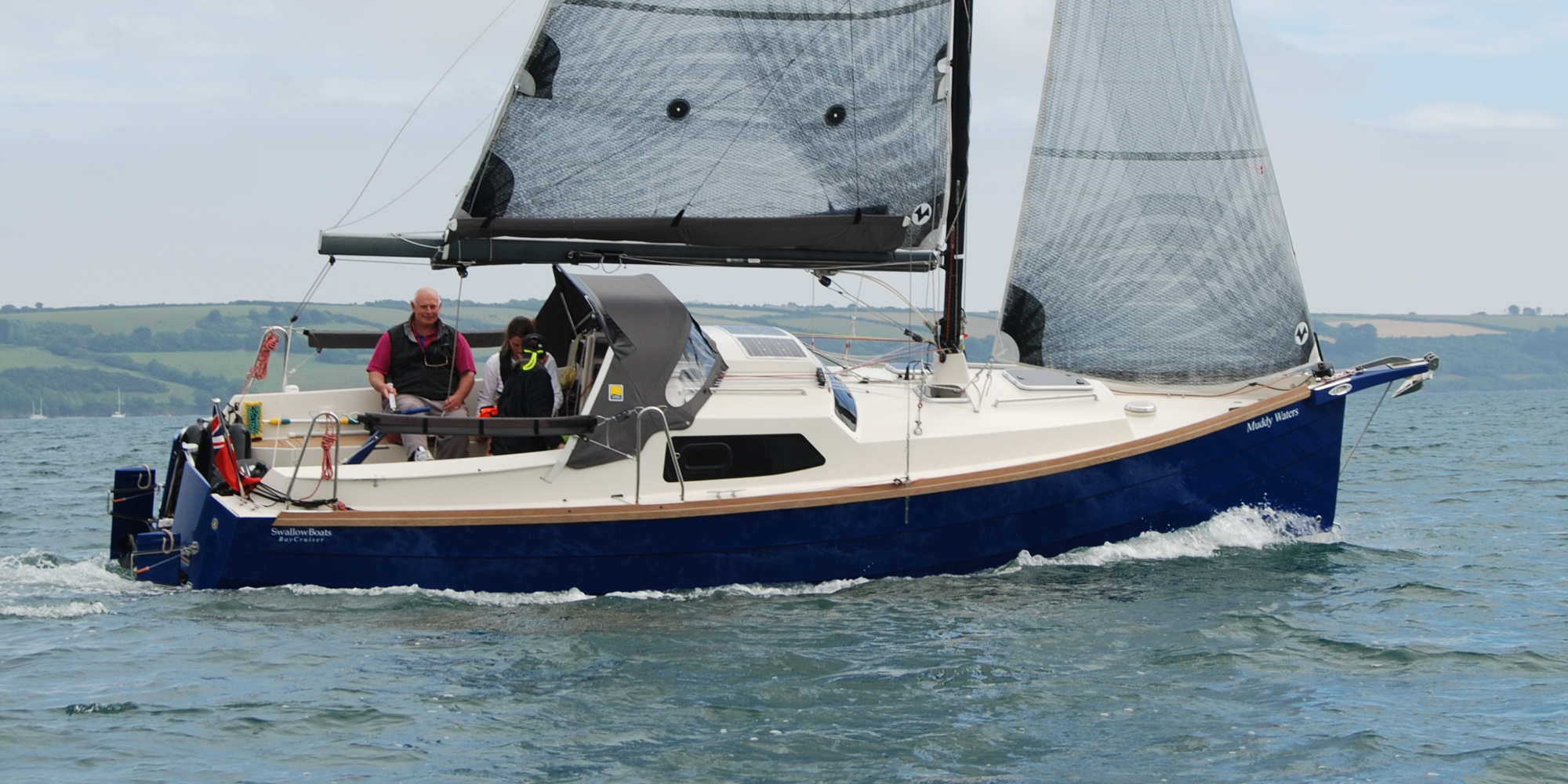
![]() Thanks to her water ballast, she very light on the trailer and was towed to 500 miles to France behind a 1.4 litre Renault Megane Special thought has been given to the speed with which she can be rigged. A boat like this can be trailed to far flug destinations, and launched and recovered after each sail. Most boats take a significant time to rig, which can be tedious for friends and family who will have to endure this ordeal every time you launch and recover her. The BayRaider has a lot of built in features which mean that it takes me about 8 minutes to launch and rig the boat from her trailer, singlehanded. We hope to publish a video of this process and post it here – I can tell you don’t believe us yet! The main mast is on a tabernacle, making raising and lowering it easy. It has a dedicated tie down point on the stern deck so you don’t have to worry about what to tie to. The mizzen is a carbon and glass fibre tube which is light enough to lift out easily, after rolling the sail around it. The rudder is a beautiful stainless fabrication of which we are particularly proud. While being exceptionally strong, it also allows the rudder blade to come right up well clear of the water, which is handy when towing or when leaving her on a mooring. It means the rudder stays on the boat the whole time – another job that you don’t have to do when bored family are waiting, but is well clear of the water for easy launching. The 316 grade stainless steel rudder and tiller in one. The blade lifts right up enabling her to be trailed or left on a mooring with the rudder in place. The shrouds are normally left attached to the mast and boat, and the forestay used to pull tension into them. This saves having to tension each shroud individually which is time consuming. The jib is set on a roller furler as standard, which is usually mounted on a club boom for easy self tacking. Novices to sailing might be put off by a rig with three sails, but the BayRaider is exceptionally easy to handle. Her entire rig is self tacking which means going about is a simple matter of putting the helm over and swapping sides. The jib and mizzen sheets are on jamming cleats which leaves the helmsman to control the main and tiller. The cockpit on BayRaider has been an area of intense design focus. The moulded GRP floor with built in non slip surface also houses the oars in a recess either side of the centreboard case. At the after end there is a sump and self bailer, to gather and drain any spray or rainwater that finds its way onboard. The seats are high enough for comfort and good visibility, but low enough for safety and a real feeling of sitting inside the boat. The spacious cockpit provides lots of room and together with the slot-in sleeping platform, there is room for two adults to sleep under the foredeck/spray hood. Thanks to the raised cockpit floor, the centreboard case is fairly low and unobtrusive, providing excellent foot bracing when sitting out. Aft of the case there is dedicated space for a small chartplotter/fishfinder and compass, in front of the helmsman where it can be easily seen. Any batteries required can be mounted at the forward end of the case, with wiring discretely hidden under the hardwood case top plank. Forward of this there is space for the anchor, chain and warp, as well as space in the aft outboard well chambers for a kedge/reserve anchor. The position of the outboard well is ideal for motoring in rough water as the propeller is well buried and is unlikely to surface. The outboard is on the centreline, and so its wash is directed onto the rudder for superb manoeuvrability. For really tight spaces the outboard can be freely rotated as it is easy to reach under the tiller from the helming position. A short shaft outboard is needed, and as small as possible is recommended. Remember 2 HP is roughly 8 men rowing, and if your engine doesn’t have a reverse you can always rotate the head if needed.
There are two huge weather proof stowage compartments under the seats to port and starboard. Dry stowage is in any of the dedicated buoyancy compartments, or within waterproof bags within the lockers, or under the foredeck. An optional spray hood makes the forward half of the cockpit a very dry and warm space, and together with a seat piece infill, provides two feet-first berths under the foredeck. Sleeping on board an open boat like this is a huge attraction. You may not do it often, but it is possible to take her camp cruising with room for all your supplies. If you would like to find out more about the BayRaider, or have comments or questions, please fill in the form at the bottom of this page and we will be happy to help. Alternatively, there is more information about her in the pages listed below, including an order form/price list and a detailed specification document. Download the full BayRaider specification here What's so good about Water Ballast? View pictures of the first boats in build here View pictures of the launch and first test sails View pictures and video of the capsize tests |
|||